

It’s not always easy to keep up to date with the latest brand campaigns. If a week is a long time in politics, it’s a lifetime in Adland.
So, to help you stay up-to-date with all the latest ad activity, DAIVID last week launched a new column devoted to shining a light on some of the highest-performing ads of the week.
Not just the ones making the headlines, but the campaigns that truly move people. You can read our first column here.
Just to recap, each week we are using our AI-powered creative testing platform to find the ads that are delivering creative effectiveness. Our AI models are trained to identify ads that not only deliver positive emotional engagement, but also attract high scores for attention, brand recall and inspire action.
In this week’s column we pick out three brands that got our creative testing platform purring.
So pull up a chair and settle back. We are bringing you all the feels.
1.CoppaFeel! “We are CoppaFeel!”
Anyone, regardless of gender, can be affected by breast cancer – so make sure you are checking yourself regularly. That’s the resounding message of breast cancer charity CoppaFeel!’s latest ad campaign, which urges young people to check their boobs, pecs or breasts at least once a month.
The 90-second film, created through CoppaFeel!’s Youth Network and Livity, even shows viewers how it’s done by showing various shots of people checking for lumps.
It’s a very clear and effective message from the non-profit – and it scored very highly when it was run through our AI-powered testing platform.
How did it perform?
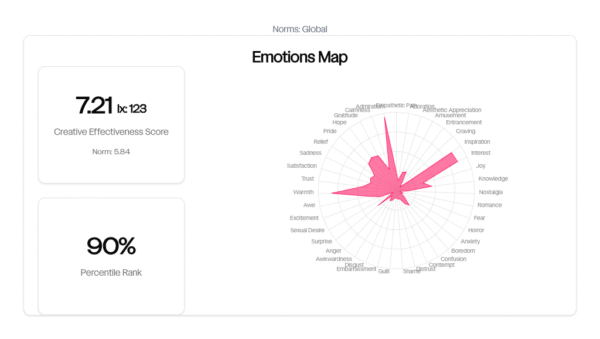
The ad scored the highest of any ad last week, putting its overall effectiveness score in the top 10% of all ads tested by DAIVID.
There are many reasons why it scored so highly. First of all, the ad was 16% more likely to generate intense positive emotions from viewers than the average ad. This is quite impressive, especially considering the sensitive subject area of the video that could easily have left people confused and embarrassed. Instead, the ad attracted intense feelings of gratitude (152% higher than average), empathetic pain (+143%) and hope (+135%).
Crucially, the ad’s straightforward message also generated very strong feelings of trust that were 105% above the norm. It also left people feeling more knowledgeable after watching, which is key. The message was understood loud and clear.
Such a clear, relatable instruction also meant that people stayed attentive throughout, with attention levels well above the norm from the first second to the last.
This also meant viewers were more likely than average to share the message with their networks and search for the brand. However, this was slightly impaired by the fact that viewers were slightly less likely than average to recall the brand correctly after watching. People clearly remembered the message, but not the brand behind it.
“We are CoppaFeel!” – Emotions Map
2. Apple: “The Underdogs: BSOD (Blue Screen of Death)”
Apple once again returns to its favourite sport of making fun of its PC rivals in a new eight-minute film
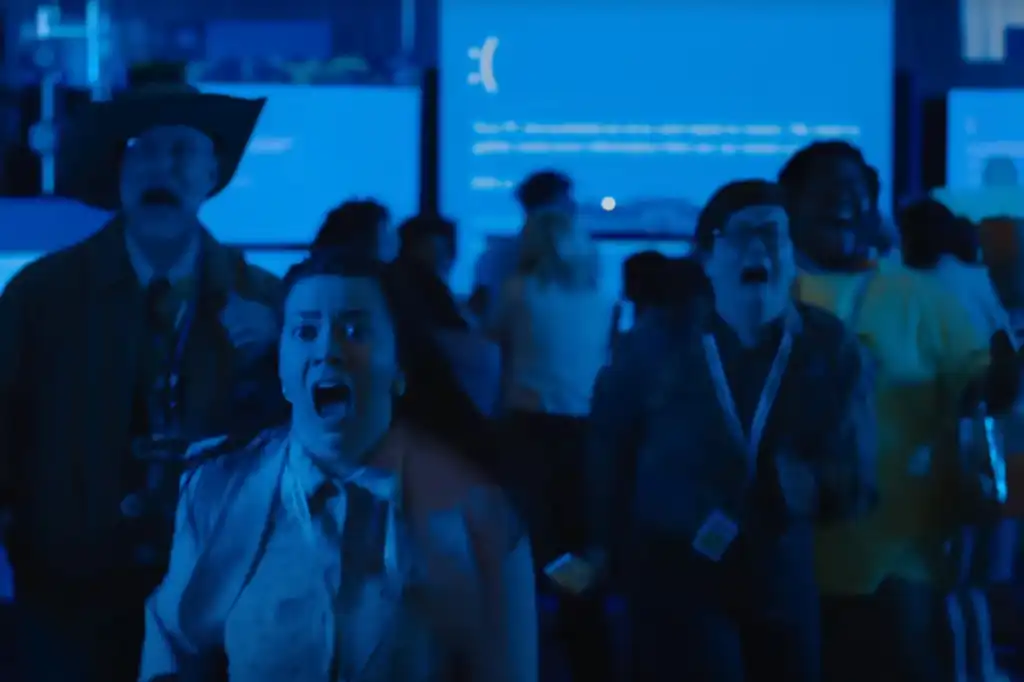
Created in-house, “The Underdogs: BSOD (Blue Screen of Death)” humorously depicts a trade show where all the Windows PCs crash with the infamous blue screen, while a fictional company who have been using Macs remain unaffected.
How did it perform?
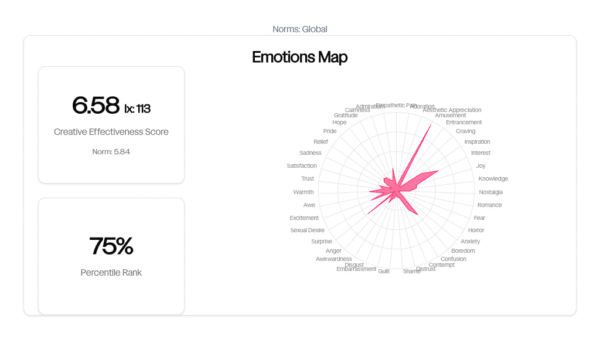
In terms of overall effectiveness, the ad managed a highly respectable CES (DAIVID’s Creative Effectiveness Score) of 6.58 out of 10. Just to put that in context, that puts it in the top 25% of ads tested by DAIVID.
This score was driven by a high amusement score. The ad was 75% more likely to laugh at the video than the average ad. In fact, overall positive emotions were 4% higher than the industry norm. As well as making people laugh out loud, the ad also managed to make people excited and surprised.
However, the long running time meant viewers were also 58% more likely to be bored, while negative emotions such as awkwardness, confusion and embarrassment were also prominent. Viewers sometimes were left squirming in their seats.
Yet despite the long running length and strong feelings of confusion and boredom, attention levels were around par for the industry throughout.
With the product and brand playing a key role in the storyline, people were also 31% more likely to correctly name the company behind the ad.
“The Underdogs: BSOD” – Emotions Map
3.Find Your Anchor: “Found At See”
“Found At See” is a powerful new brand campaign, created by Crispin Porter + Bogusky, for suicide prevention charity Find Your Anchor.
The campaign reimagines “anchors” as the everyday moments and simple joys that help people stay hopeful when life feels a little choppy. The campaign includes this moving 60-second film directed by Kaitlin Scott.
How did it perform?
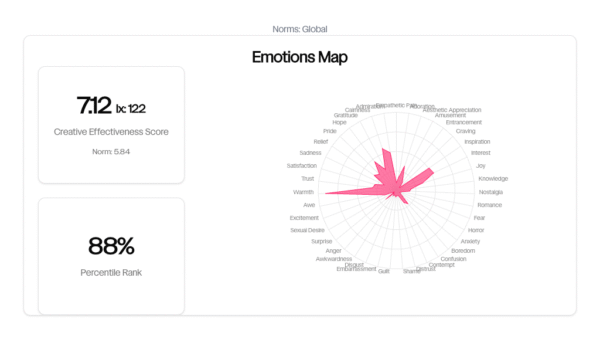
“Found At See” is certainly a powerful watch, scoring in the top 12% of ads ever tested by DAIVID. Key to this was the ad’s ability to generate intense positive emotions. Overall, the ad attracted 5% more positive engagement than the average ad, quite a feat considering the serious subject matter.
Crucially, the most prominent emotions the ad managed to extract from viewers were intense feelings of hope (156% above the norm), calmness (+132%) and warmth (+94%).
The ad also managed to maintain people’s attention throughout the entire 60 seconds, with attention levels well above the industry average. Despite the beautiful execution, the one negative was below average brand recall. In fact, viewers were 45% less more likely to think there was no brand involved than the norm.
This confusion around the brand behind the creative meant that people were less likely than average to act after watching the ad, with the percentages of people willing to recommend the brand, make a donation or search for the brand all well below the norm. More visible branding throughout and a clear call to action would have seen the ad score even higher.
“Found At See” – Emotions Map
Notable mention:
The Ordinary: “The Periodic Table”
The Ordinary takes aim at the beauty industry’s misleading marketing jargon in a new ad created by Uncommon.
Based on The Periodic Table, the ad swaps scientific elements for 49 marketing buzzwords to make the point that there’s zero science behind many of the claims made by beauty brands.
The concept of using a Periodic Table of Marketing Buzzwords is brilliantly visualised in this clever creative, which really drives home the no-nonsense brand’s rejection of pseudoscience and overcomplicated jargon.
The ad’s interesting use of visuals and strong, honest message generated strong feelings of entrancement, trust and knowledge.
To find out more about DAIVID’s AI-powered creative testing platform, click here.